Introduction
Optimizing the free parameters of a trading strategy on historical data is an invitation to overfit. With enough configurations tried, some will look excellent in sample purely by chance and collapse out of sample [3, 7, 11]. The standard statistical responses correct the selected performance for the number of trials and for non-normality—the Deflated Sharpe Ratio (DSR) [5], the Probability of Backtest Overfitting (PBO) [3], and data-snooping reality checks [6, 14].
A second, more geometric piece of advice circulates widely in practitioner writing [2, 11, 12]: do not just take the best parameter set, look at the shape of the objective around it. A broad “plateau” of similar performance is presumed robust; a narrow “peak” that collapses one grid step away is presumed to be fitted noise. The intuition mirrors the flat-minima literature in machine learning, where wide minima are argued to generalize better than sharp ones [8, 10]. Modern hyperparameter tooling makes the geometry easy to inspect—slice plots, contour heatmaps, and functional ANOVA importances [1, 9]—and several authors propose scalar “plateau metrics” (sensitivity ratios, plateau widths, robustness scores) to formalize it.1
Despite its popularity, the plateau heuristic has, to our knowledge, never been tested where the truth is known. Does plateau geometry actually predict out-of-sample degradation? Are the proposed scalar metrics and their thresholds meaningful? How do they compare to, and combine with, the statistical diagnostics designed for the same problem? We answer these questions in a controlled simulation and report results that are useful precisely because they are mixed.
Contributions.
A reproducible simulation framework in which the population Sharpe surface over a hyperparameter grid is known, so selection quality, in-sample inflation, and out-of-sample performance are all measurable ground truth (Section 3).
A head-to-head evaluation of the plateau metrics against PBO, DSR, and the plain probabilistic Sharpe ratio (PSR) as overfitting classifiers, with bootstrap confidence intervals. The shape metrics are weak alone (no-edge ROC AUC 0.501 in one dimension, i.e. chance); the strongest single diagnostic is the PSR against zero skill (AUC 0.808), ahead of the DSR (0.785) and PBO (0.669), and the article-style fixed thresholds do not correspond to calibrated decision boundaries (Section 5.1).
Evidence that geometry and statistics detect different overfitting modes, so that a combined classifier significantly improves detection of the sharp-peak fragile mode—and of every mode in two dimensions—while adding nothing significant over the plain PSR for no-edge detection in one dimension (Sections 5.2–5.3). We also show the geometry must be anchored at the surrogate optimum: measured at the naive argmax instead, the same metrics become anti-informative (Section 5.4).
A demonstration that, as a selection rule, preferring the broad optimum of a denoised landscape delivers a real out-of-sample gain that is positive in every curvature tercile, grows with the sharpness of the surrogate optimum and with dimensionality, and depends on the surrogate bandwidth in a disclosed way (Section 5.5).
Background and metrics
Setting.
A strategy is evaluated at configurations \theta on a grid \Theta \subset [0,1]^d. Each configuration produces a return series; over a sample of T periods its annualized Sharpe ratio is estimated as \widehat{\mathrm{SR}}(\theta) = \bar r(\theta)/s(\theta)\sqrt{P} with P=252. The optimizer reports \hat\theta= \arg\max_{\theta} \widehat{\mathrm{SR}}_{\text{IS}}(\theta); the quantity that matters is the realized out-of-sample \mathrm{SR}_{\text{OOS}}(\hat\theta).
Plateau metrics.
We study the local-geometry metrics of the practitioner tradition, computed from the in-sample Sharpe landscape, fixing estimator flaws we observed in circulating implementations. First, per-parameter quantities are taken along the axis through the optimum with the other parameters held fixed (exact on a grid), rather than by regressing over top trials in which all parameters co-vary. Second, the plateau width is the connected super-level set around the optimum, not \max-\min over all “good” points, which a single distant lucky point inflates.
For axis i, with optimum value \mathrm{SR}^\star and margin \delta (in Sharpe units), the relative plateau width is \begin{equation} W_i \;=\; \frac{\big|\{\,\text{contiguous run through }\hat\theta: \widehat{\mathrm{SR}}(\theta)\ge \mathrm{SR}^\star-\delta\,\}\big|}{\text{axis length}} \in [0,1]. \end{equation} The sensitivity is the Sharpe drop when stepping a fixed fraction of the axis away from the optimum (well defined for any sign of \mathrm{SR}^\star, unlike the elasticity used in some sources, whose first-derivative term vanishes at an interior maximum). The robustness score aggregates widths with first-order functional-ANOVA weights w_i [9]: \begin{equation} R \;=\; \prod_{i=1}^{d} W_i^{\,w_i}, \qquad \textstyle\sum_i w_i = 1 . \label{eq:R} \end{equation} A high R is meant to signal robustness; a common rule of thumb labels R>0.1 “robust” and R<0.01 “overfit.” Note that in d{=}1 there is a single axis with unit weight, so R \equiv W_1: the robustness score and the plateau width coincide by construction. Finally, the outlier gap asks whether the best few cells are outliers relative to typical performance: G = \mathrm{mean}\big(\text{top-3 } \widehat{\mathrm{SR}}\big) - \mathrm{median}\big(\widehat{\mathrm{SR}}\big). The practitioner version is the ratio of top-3 to median, which is ill-posed whenever the median Sharpe is near zero or negative—exactly the no-edge landscapes that matter most; the difference form preserves the intent and is well defined everywhere.
Statistical baselines.
We compare against three standard diagnostics computed on the same returns. The Probability of Backtest Overfitting [3] uses combinatorially-symmetric cross-validation (CSCV): the T observations are split into S blocks; over all \binom{S}{S/2} train/test partitions one records the relative out-of-sample rank of the in-sample-best strategy, and PBO is the fraction of partitions in which that rank falls below the median. The probabilistic Sharpe ratio [4] \mathrm{PSR}(\mathrm{SR}^{*}) is the probability that the true Sharpe exceeds a benchmark \mathrm{SR}^{*}, given the sample length, skewness, and kurtosis of the selected strategy’s returns; \mathrm{PSR}(0) tests significance against zero skill with no multiplicity correction. The Deflated Sharpe Ratio [5] is \mathrm{PSR}(\mathrm{SR}_0) with the benchmark set to the expected maximum Sharpe of N independent null trials, \begin{equation} \mathrm{SR}_0 \;=\; \sqrt{V}\Big[(1-\gamma)\,\Phi^{-1}\!\big(1-\tfrac1N\big) + \gamma\,\Phi^{-1}\!\big(1-\tfrac1{Ne}\big)\Big], \end{equation} where V is the cross-trial variance of the Sharpe estimates and \gamma is the Euler–Mascheroni constant; a low DSR flags a selection that is not significant once the number of trials and non-normality are accounted for. We set N to the full grid size (41 in d{=}1, 1681 in d{=}2). This follows common practice but overstates the effective number of trials: grid trials are strongly correlated (a shared market factor plus a smooth true surface), and [5] prescribe the number of effectively independent trials. We disclose this choice and report a sensitivity check in Section 5.1.
Simulation framework
We treat backtest optimization as selecting from a grid of noisy estimates of a known surface. The population annualized-Sharpe surface \mathrm{SR}_{\text{true}}(\theta) is a sum of a broad Gaussian bump (the plateau) and an optional narrow Gaussian bump (the spike), on a floor \mu_0: \begin{equation} \mathrm{SR}_{\text{true}}(\theta) = \mu_0 + A_p \exp\!\Big(\!-\tfrac{\|\theta-c_p\|^2}{2\ell_p^2}\Big) + A_s \exp\!\Big(\!-\tfrac{\|\theta-c_s\|^2}{2\ell_s^2}\Big). \end{equation} Each configuration emits per-period returns r_t(\theta) = \mathrm{SR}_{\text{true}}(\theta)/\sqrt{P} + \sqrt{c}\,F_t + \sqrt{1-c}\,\varepsilon_t(\theta), with a shared market factor F_t and idiosyncratic \varepsilon, both standard normal; the factor share c equals the cross-strategy correlation and is the structure PBO and DSR are designed for. We draw independent in-sample (T_{\text{IS}}\in\{120,252,504\}) and out-of-sample (T_{\text{OOS}}=504) blocks.
Surrogate.
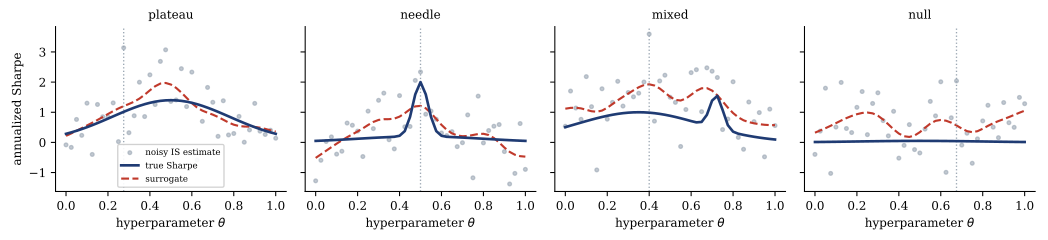
At T_{\text{IS}}=252 the per-configuration Sharpe estimate has noise of order 1.0 annualized, so the raw per-cell surface is dominated by noise and any argmax looks like a needle. Practitioners never read raw per-point values; they assess the landscape through a surrogate—the smoothing implicit in contour plots and functional ANOVA. We model that surrogate with a Gaussian kernel of disclosed bandwidth and compute all plateau geometry on it (Figure 1). The statistical baselines act on the raw returns, as their definitions require. Boundary handling matters more than one might expect: padding the convolution by replicating edge values concentrates roughly half the kernel mass onto a single boundary cell, inflating its noise variance; in a flat-null check, 39.9\% of surrogate argmaxes then land in the outer three cells per side, versus 14.6\% under uniformity. We therefore use mask-normalized smoothing (zero-padded convolution divided by the convolution of a ones mask), which removes the weighting artifact; the residual edge share (29.7\% in the same check) reflects the genuinely higher estimation variance where fewer neighbors are observed, not a weighting bias.
Selection rules and outcomes.
The naive rule selects the raw argmax; the plateau-aware rule selects the surrogate argmax, which prefers a broad maximum over a lucky isolated spike. Because the truth is known we record, for each experiment, the oracle configuration \arg\max \mathrm{SR}_{\text{true}}, the true regret \mathrm{SR}_{\text{true}}(\text{oracle})-\mathrm{SR}_{\text{true}}(\hat\theta), the in-sample\toout-of-sample inflation gap, and the realized OOS Sharpe of each rule, alongside every diagnostic.
Experimental setup
Each experiment samples a random landscape from one of four families—wide plateau, sharp needle, mixed (plateau plus a taller spike), and null (no edge)—with randomized amplitudes, widths, centers, factor share and in-sample length, on a grid of 41^d configurations. We run N{=}5{,}000 one-parameter and N{=}4{,}000 two-parameter problems. PBO uses S{=}10 blocks; the plateau margin is \delta{=}0.25 Sharpe. The surrogate bandwidth is 0.06 of the axis, i.e. \sigma = 2.4 grid cells: the a-priori rationale is that this sits well below the true plateau scales of the generator (\ell_p \in [0.15, 0.45], i.e. 6–18 cells), so the kernel averages away cell-level noise without erasing plateau-scale structure. It was not tuned to the results, but it is a choice, and Section 5.5 reports the selection payoff across bandwidths 0.03–0.16 in both dimensions, including where it degrades.
We score each diagnostic against three ground-truth binary labels capturing distinct overfitting modes: no-edge, the selected configuration has true Sharpe below 0.25 (deployed something essentially worthless); fragile, true regret exceeds 0.5 (left real edge on the table by landing on a fragile or wrong point); and OOS-loss, the selected configuration loses money out of sample. Labels are defined for the naive selection—the behavior the diagnostics are meant to audit—while the plateau geometry is anchored at the surrogate optimum, the heuristic’s own object; Section 5.4 quantifies how much this anchoring choice matters. Discriminative power is the ROC AUC of the (orientation-aligned) diagnostic, with 95\% confidence intervals from 1{,}000 bootstrap resamples of the experiment records; complementarity is the cross-validated AUC of an L_2 logistic combination (scaler and classifier fitted inside each fold). To verify the conclusions are not artifacts of the label cutoffs we recompute the full AUC table with the no-edge threshold in \{0.15, 0.25, 0.35\} and the fragile threshold in \{0.35, 0.5, 0.65\}: AUCs shift by at most 0.05 (0.07 for the single near-chance outlier-gap/fragile cell), and the best diagnostic for each label never changes. All code, seeds and the exact configuration are released.
Results
As standalone diagnostics: significance tests dominate, shape metrics do not
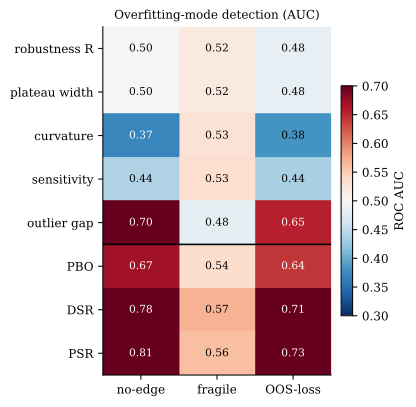
Figure 2 and Table 1 report detection AUCs. Three findings stand out.
First, the plateau-shape metrics are weak. In one dimension the robustness score is at chance for the no-edge mode (AUC 0.501) and barely above it for fragile (0.520); curvature is anti-predictive of no-edge (0.369), because a sharp surrogate peak indicates that some real signal exists—the opposite of the no-edge case. The article-style fixed thresholds inherit this weakness: at R>0.1 the implied “robust” subset (52\% of the one-dimensional experiments) has an overfit base rate of 38.6\% versus 38.5\% overall, so the threshold separates nothing; in two dimensions 92\% of experiments pass it.
Second, the strongest single diagnostic is the plain PSR against zero (no-edge AUC 0.808, OOS-loss 0.733), ahead of the DSR (0.785, 0.713) and PBO (0.669, 0.643). The explanation is unglamorous: the no-edge label (“selected configuration has true Sharpe below 0.25”) is close to the PSR’s own null hypothesis, so the significance test against zero is nearly tailor-made for it—and the DSR’s multiplicity deflation adds nothing to the ranking. The deflation benchmark \mathrm{SR}_0 is proportional to the cross-sectional dispersion of Sharpe estimates, which in our generator is largest exactly when a real edge exists, so deflating partially cancels the signal. Consistently, recomputing the DSR as if only 10\% of the grid trials were independent (i.e. less deflation, arguably more honest given the correlated trials noted in Section 2) slightly raises its no-edge AUC, from 0.785 to 0.802 in d{=}1 and from 0.735 to 0.743 in d{=}2. None of this says the DSR is wrong—it is a calibrated significance test, and AUC measures ranking, not calibration—but for ranking overfitting risk in this setting the deflation term contributes no discriminative power beyond the underlying PSR.
Third, the one genuinely informative geometry-family diagnostic is the outlier gap (no-edge AUC 0.703 in d{=}1 and 0.837 in d{=}2—where it is the best diagnostic of any kind). Note what it measures: whether the best cells stand far above typical performance, i.e. signal amplitude on the smoothed landscape, not shape. The practitioner intuition that survives validation is “check that the top of the landscape clears the typical level,” not “check that the top is wide.”
| One parameter (d{=}1) | Two parameters (d{=}2) | |||||
| Diagnostic | no-edge | fragile | OOS-loss | no-edge | fragile | OOS-loss |
| Robustness score R | 0.501 | 0.520 | 0.483 | 0.558 | 0.585 | 0.519 |
| Plateau width | 0.501 | 0.520 | 0.483 | 0.546 | 0.587 | 0.510 |
| Curvature | 0.369 | 0.528 | 0.380 | 0.431 | 0.635 | 0.449 |
| Outlier gap | 0.703 | 0.481 | 0.655 | 0.837 | 0.478 | 0.719 |
| PBO | 0.669 | 0.535 | 0.643 | 0.727 | 0.585 | 0.670 |
| DSR | 0.785 | 0.570 | 0.713 | 0.735 | 0.573 | 0.656 |
| PSR | 0.808 | 0.560 | 0.733 | 0.759 | 0.580 | 0.669 |
Where combining geometry with statistics helps—and where it does not
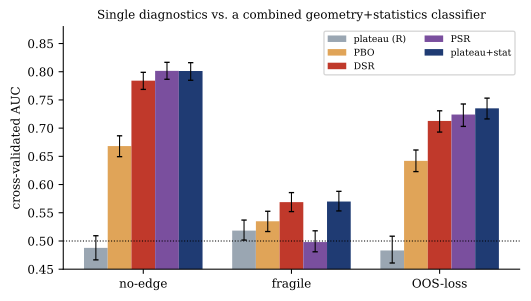
The two families specialize. Statistical diagnostics excel at the no-edge mode—selecting from pure noise—which is what they were built for. Plateau geometry, by construction, sees the shape of the optimum and contributes on the fragile mode, but is blind to no-edge: a flat null surface smooths into a wide, benign-looking plateau (Figure 1, rightmost panel). The risk-oriented diagnostics are only weakly correlated across families (Spearman |\rho|\le 0.28 between R and PBO/DSR/PSR in d{=}1), so there is information to combine—but the bootstrap confidence intervals show the gain is conditional, not universal (Figure 3).
In one dimension, the logistic combination of geometry and statistics (R, curvature, PBO, DSR) significantly improves on the DSR for no-edge (\Delta\mathrm{AUC} = +0.017, 95\% CI [+0.008, +0.026]) and OOS-loss (+0.022, [+0.011, +0.034]), but not for fragile (+0.001, [-0.010, +0.012]). Against the plain PSR the combination adds nothing significant on no-edge (-0.000, [-0.010, +0.009]; both reach AUC 0.801 vs. 0.801) or OOS-loss (+0.011, [-0.001, +0.023]); it wins only on fragile (+0.072, [+0.050, +0.094]), where the PSR is at chance. In two dimensions the picture is cleaner: the combination significantly beats every single diagnostic in its feature set on every label (vs. DSR: +0.039 no-edge, +0.093 fragile, +0.037 OOS-loss; all intervals exclude zero), reaching AUC 0.774/0.664/0.692. One honest caveat: the feature set was fixed in advance to the folklore comparison (shape metrics + PBO + DSR), and in d{=}2 the outlier gap alone (AUC 0.837) beats this combination on no-edge—so the combination numbers understate what a fuller model could do, and we report them as a test of the “shape complements statistics” claim, not as a best-possible detector.
Dimensionality helps the geometry, with a caveat
The right half of Table 1 repeats the analysis with two hyperparameters. Overfitting is worse—base rates of every failure mode rise—and the geometry gains traction: the robustness score’s no-edge AUC rises from 0.501 to 0.558 and its fragile AUC from 0.520 to 0.585; curvature becomes the single best fragile detector (0.635); and the amplitude-style outlier gap strengthens most (0.703 \to 0.837), overtaking every statistical diagnostic for no-edge and OOS-loss detection. The significance tests weaken slightly (PSR 0.808 \to 0.759) as the grid grows from 41 to 1{,}681 correlated trials. The combined classifier’s advantage over the best single statistical diagnostic widens accordingly (Section 5.2), and the fragile mode—where shape information lives—is detected at 0.664 versus at most 0.585 for any statistical diagnostic alone. The caveat: even in d{=}2 the shape metrics on their own remain modest (0.5–0.6); what grows with dimensionality is their marginal value in combination, and the amplitude signal, not standalone shape-based detection.
Anchoring matters: geometry inverts at the naive optimum
The plateau geometry above is measured at the surrogate’s own argmax, while the labels describe the naive selection. This is the heuristic’s intended use (assess the denoised landscape, then act on it), but it is a choice, and we quantify it: every experiment also records the same metrics anchored at the naive argmax on the same surrogate. Anchored there, the geometry inverts: the robustness score’s no-edge AUC falls from 0.501 to 0.418 in one dimension and from 0.558 to 0.203 in two—decisively anti-informative. The mechanism is instructive. On a no-edge landscape the surrogate around the noise-selected point is flat, so naive-anchored geometry reports a wide, benign plateau precisely when the selection is pure luck; when a real edge exists the surrogate has structure and the same metrics report more fragility. Plateau geometry is a property of the denoised landscape at its own optimum, not of whatever point the optimizer returned; practitioners who compute plateau metrics around the raw optimizer output—the most natural implementation—should expect the inverted behavior.
As a selection rule, “prefer plateaus” works
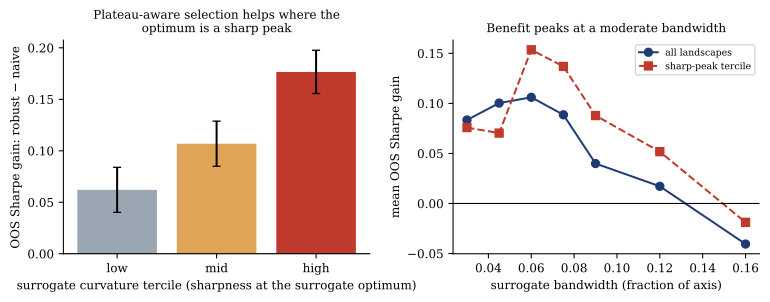
The practical question is not only whether geometry diagnoses overfitting but whether acting on it helps. Table 2 and Figure 4 compare the naive and plateau-aware selection rules out of sample. Preferring the surrogate optimum raises mean OOS Sharpe from 1.12 to 1.24 in one dimension (+0.115; Wilcoxon p \approx 7\times10^{-19}) and from 0.86 to 1.17 in two (+0.307; p \approx 4\times10^{-71}). In d{=}1 the two rules pick the same cell in 21\% of experiments; among non-ties the plateau-aware rule wins 56\% of the time with a median gain of +0.144. The gain rises monotonically with the curvature of the surrogate at its optimum: +0.062 in the flattest tercile (one-sample t-test p = 0.005), +0.107 in the middle, +0.177 in the sharpest for d{=}1; and +0.091/+0.257/+0.575 for d{=}2 (all p < 10^{-3}). The rule is targeted insurance against the sharp-peak failure mode, and on these landscapes the insurance costs nothing: even in the smoothest tercile, where it should be least needed, the expected payoff is small but positive rather than zero.
Two qualifications keep this honest. First, the baseline is the weakest defensible one—the raw argmax of an unsmoothed noisy surface—so the result demonstrates the value of denoised selection, of which “prefer plateaus” is one instance, not superiority over any sophisticated alternative. Second, the magnitude depends on the surrogate bandwidth (Figure 4, right). In d{=}1 the mean gain is +0.100, +0.106, and +0.089 at bandwidths 0.045, 0.06, and 0.075, decays to +0.040 at 0.09 and +0.017 at 0.12, and turns negative (-0.041) at 0.16, where smoothing erases real structure; the sign flips at roughly 0.14 of the axis. In d{=}2 the gain is positive across the entire tested range (from +0.381 at bandwidth 0.045 to +0.151 at 0.16). Finally, an implementation note: an earlier version of our surrogate used boundary-replicating padding, which inflates noise variance at the grid edges and piles the “robust” selection onto boundary cells of flat landscapes; fixing this (mask-normalized smoothing, Section 3) raised the mean gains and made the flattest-tercile payoff positive. Geometry heuristics inherit the artifacts of the smoother they are computed on.
| One parameter | Two parameters | |
|---|---|---|
| Naive argmax (mean OOS Sharpe) | 1.123 | 0.862 |
| Plateau-aware (mean OOS Sharpe) | 1.238 | 1.170 |
| Mean gain | +0.115 | +0.307 |
| Median gain (non-tie pairs) | +0.144 | +0.280 |
| Win rate / ties / non-tie win rate | 0.44 / 0.21 / 0.56 | 0.59 / 0.04 / 0.61 |
| Gain, low-curvature tercile | +0.062 | +0.091 |
| Gain, mid-curvature tercile | +0.107 | +0.257 |
| Gain, high-curvature tercile | +0.177 | +0.575 |
Discussion
The results reconcile two views that are usually stated as competitors, but not in the way the folklore expects. The statistical school treats overfitting as a multiple-testing problem; the geometric school treats it as a fragility problem and inspects the shape of the optimum. Three honest lessons emerge. First, for detecting a worthless selection, the workhorse is the plain significance test: the PSR against zero is the strongest single diagnostic here, and the DSR’s multiplicity deflation—with trials as correlated as a grid scan—contributes calibration, not ranking power. Second, the plateau heuristic’s shape metrics and rule-of-thumb thresholds are weak or uncalibrated as standalone tests, and become actively misleading if anchored at the raw optimizer output; what survives of the diagnostic intuition is the amplitude check (does the top of the denoised landscape clear the typical level?) and a complementary contribution on the fragile mode, mainly in higher dimension. Third, the heuristic’s action—select the optimum of a denoised landscape rather than the raw argmax—is the clearest win: a real, monotone-in-sharpness out-of-sample improvement that grows with the number of parameters. “Prefer plateaus” is best understood not as a test but as a regularizer on selection.
Limitations
Our generative model uses Gaussian, serially independent returns with a single shared factor; real returns have fat tails, volatility clustering, regime shifts, and richer dependence that all amplify overfitting and may change the relative ranking of diagnostics. We model the optimizer as exhaustive grid evaluation plus a fixed-bandwidth smoothing surrogate; an adaptive sampler (e.g. TPE or Gaussian processes) explores unevenly and would interact with the geometry metrics differently. The labels and thresholds, while ground-truth-based, involve choices (\delta, the surrogate bandwidth, the label cutoffs); we stated the a-priori rationale for the bandwidth, showed the AUC conclusions are stable across label cutoffs (Section 4), and reported rather than hid the bandwidth dependence of the selection gain, including the sign change near 0.14 of the axis in one dimension. The DSR is computed with N equal to the full grid size despite correlated trials; the N_{\text{eff}} sensitivity check (Section 5.1) suggests this does not drive the comparison. Finally, we study Sharpe-based selection on a single asset; portfolio-level and turnover/cost-aware objectives are left to future work.
Conclusion
We gave the plateau-versus-peak heuristic of trading-strategy optimization its first controlled validation against ground truth and against the standard backtest-overfitting diagnostics. As standalone overfitting tests, the local plateau-shape metrics are weak, their popular fixed thresholds are not calibrated, and the strongest single diagnostic is the plain probabilistic Sharpe ratio against zero—the significance test, not the multiplicity deflation, carries the detection signal in this setting. Geometry contributes where shape information exists: the (re-posed) outlier gap is the best no-edge detector in two dimensions, and combining shape metrics with statistical diagnostics significantly improves fragile-mode detection. Acting on the geometry—selecting the optimum of the denoised landscape rather than the raw argmax—delivers a real, targeted out-of-sample improvement that is positive in every curvature tercile and grows with dimensionality. Prefer plateaus as a selection bias; do not rely on them as a test; and pair them with a significance test, which sees the failure mode that shape cannot.
Reproducibility.
All experiments are deterministic given the released seeds. A single
command (python scripts/run_all.py) regenerates every
number—including the bootstrap confidence intervals and sensitivity
checks—and python -m plateau_experiments.figures
regenerates every figure; a companion script
(scripts/check_paper_numbers.py) asserts that every value
quoted in this paper’s tables and text matches the generated results.
The implementation of the metrics, the PBO/CSCV, PSR and DSR baselines,
and the simulation is provided as an open-source package.
References
The specific scalar metrics we validate—robustness score, plateau width, sensitivity, and the top-versus-typical outlier check—follow the author’s earlier practitioner article [13], where they were proposed without ground-truth validation; the present paper subjects them to their first controlled test.↩︎